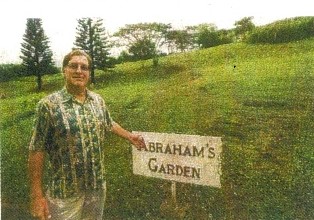
Abraham’s Garden Offers Final Seclusion
In keeping with Jewish rituals embracing humble simplicity, there are no headstones or bunches of decorative flowers in Abraham’s Garden. The peaceful field of a cemetery in Hawaiian memorial Park in Kaneʻohe consists of 100 burial plots. Don Armstrong, sole owner and manager of Abraham’s Garden, says the cemetery reflects the scriptural view, “We come into this world with nothing, and we leave with nothing.” Armstrong, longtime president of Congregation Sof Maʻarav — a lay-led, egalitarian congregation affiliated with the United Synagogue of Conservative Judaism — founded Abraham’s Garden in 2011 because the Jewish cemetery owned by Temple Emanu-El at Mililani Memorial Park was running out of space, he said. He will conduct an informational meeting and tour of the cemetery, in Hawaiian Memorial Park’s Meditation II section, on Oct. 25 for anyone of the Jewish faith interested in buying “rights of interment.” The event begins at 10 a.m. at the park’s main office, 45-425 Kamehameha Highway. According to tradition, Jewish people are buried apart from those of different faiths, separated by a physical boundary, based on “a commandment from antiquity,” Armstrong said.
The cemetery permits only burial of Reform, Conservative, Reconstructionist, and Orthodox Jews by matrilineal descent or conversion. But because many ancestral records were destroyed during World War II, “we will let people attest to the nature of their Judaism” through affidavit, Armstrong said. He estimates that 15,000 Jews live in Hawaiʻi. The practice of maintaining separate burial areas extends to non-Jewish family members, who may be interred in a “Jewish Family Section” at Abraham’s Garden. But in the interest of inclusion and “because intermarriage is a fact of modern Jewish life … we will accommodate the contiguous burial of non-Jewish family members along the boundary between the two sections,” Armstrong said. This boundary is signified by unobtrusive, in-ground markers. Abraham’s Garden is further separated from other cemeteries on four sides by an access road, a hedge, a walkway and a chain fence. To accommodate another ritual, Hawaiian Memorial drills holes in the concrete liners of each grave site “so that the remains can come in contact with earth. The casket is made of wood so that it can naturally decompose and permit the remains to return to the earth,” Armstrong said.
Jews believe man was formed from earth and must return to that state—from “dust to dust,” according to Hebrew Scripture. That’s why, Armstrong said, “cremation is discouraged. The body must be respected; cremation also echoes the Holocaust.” A bucket of earth and a spade and shovel are provided for mourners to use at burial services. And a faucet and basin are used for ritual cleansing afterward. A remembrance ceremony is held when the grave marker is unveiled, usually at the first anniversary of the burial. Visitors mark their presence by leaving a small stone on the grave marker, and the cemetery provides a bucket of stones for this purpose. “Flowers are usually not seen at funerals or grave sites; instead, family and friends are encouraged to make a donation to charity and/or their synagogue in remembrance of the deceased,” Armstrong said. Abraham’s Garden does not permit headstones. A granite or bronze grave marker, however, is required at each burial plot, he said. For information about the site visit, contact Armstrong at 772-0262 or sandrazarmstrong@gmail.com.
Originally published in Honolulu Star Advertiser, Saturday 10/1/2018, by Pat Gee
The Conversation
This week I gave the drash at Sof Ma’rav for Shabbat Shuvah. Shabbat Shuvah, the Sabbath of Return, is also known as Shabbat T’shuvah, the Sabbath of Repentance. It is a time of introspection when we publicly admit our sins, individually and as a community, to our fellow humans and to God. It is a time to repent, to ask for forgiveness, and to resolve to do better. We hope and pray that God will inscribe us in the Book of Life for another year.
In my drash I talked about the surprise of my near death experiences and the questions they raised: Are my affairs in order? Have I made things right with my family and friends? Am I ready to be judged?
I also talked about the need to have the “Conversation” with family and friends. What is the Conversation about? It is about making the necessary arrangements before you are denied inscription into the Book of Life. It is about having a good death, not a difficult, messy one.
My drash talked about three aspects of the Conversation: (1) the unpredictability and the certainty of death; (2) procrastination and its adverse impact on families when their loved one passes; and (3) the need for shalom bayit in the preparations for death.
I concluded my drash with the Conversation. The Conversation is a simple one: You will not live forever. You may die sooner than you expect because bad stuff can happen to anyone. Get your affairs in order. Purchase burial plots and burial services when you are able to do so. Don’t wait until you are no longer capable of doing so. Don’t burden your spouse, your children or other kin with your loose ends. They should be comforting you in your final days and grieving for themselves. Have a good death, not a difficult, messy one.
As many of you know, I am the owner and sole manager of Abraham’s Garden, a Jewish cemetery located in Hawaiian Memorial Park in Kaneohe. I got into the cemetery business because when I went to purchase Jewish burial plots, there was no space available for my wife and me to be buried together. This is not a commercial for Abraham’s Garden. You should have the Conversation wherever you decide to be buried. I feel strongly about this topic because of recent experiences with difficult, messy deaths.
So what is a good death? It is a death with shalom bayit, a death where all family affairs and relationships are put in order before the grief caused by the passing of a loved one. It is a death like Moshe’s, not a death like King David’s. Moshe made his peace with God and his people as they crossed into the Promised Land without him. His was a good, organized, well-prepared death: King David, not so much. His old age was on the precipice of catastrophe, with succession intrigue, manipulation, confusion, and near disaster.
I implore you not to procrastinate. Have the Conversation with your family and friends. Make your peace with them so you can rest in peace. This way you will not burden your loved ones and they can focus on comforting you in your final days.
May you have an easy fast and be inscribed in the Book of Life for another year.
Donald Armstrong,
Past President, Congregation Sof Ma’arav, Owner and Manager, Abraham’s Garden
 Jewish Girl Meets Not-So-Jewish Boy